
Sponsored by Toast
Your team wants to save time. Your guests want to talk to a person. Here's how to give them both.
Food and beverage costs are up, margins are thin, and the holiday rush is about to stretch every manager in the building. It's no surprise AI keeps coming up in conversations about how to do more with the same hours.

But is it worth it, and where do guests draw the line?
This summer, Toast surveyed 400 Canadian restaurant managers and 500 Canadian diners to find out. The short version: managers using AI are seeing real results, but guests care a lot about where you use it.
Here are 5 places AI is worth trying before 2027, and 2 places to tread carefully…
Worth trying:
1. Scheduling and Administrative Tasks
This is where most operators see the fastest payoff. 88% of managers using AI save at least three hours of admin a week, and 71% of them use it to build staff schedules.
List the admin tasks that eat the most of your managers' week.
Start with one: schedules, sales recaps, or end-of-day reports.
Decide upfront where those saved hours go (on the floor, training, guest follow-up).
2. Inventory and Food waste
This was the AI use managers were most interested in exploring. Linking sales and inventory data can flag stock close to expiry and build smarter prep lists before over-ordering becomes a habit.
Track your top 10 items by cost and waste for one month.
Compare prep levels to actual sales by day of week.
Look for tools that use your own sales data, not generic averages.
3. Marketing
Marketing is the #1 way restaurants already use AI, and the top investment priority for the next 12 months (23% of managers). Think guest emails, social captions, and holiday promotions, written faster without losing your voice.
Use AI for a first draft, then edit it so it sounds like you.
Plan your holiday gift card and New Year's promotions now.
Keep it personal: guests can tell when nobody read the message.
4. Tools that connect to what you already use
After cost (23%), the biggest barriers to adoption are lack of integration with existing systems (22%) and lack of training (18%). A tool that doesn't talk to your POS usually means more double entry, not less.
Ask any vendor: does this connect to my POS, scheduling, and inventory?
Ask what training and support are included.
Add up the monthly cost of all your separate tools before adding another.
5. Proof before you buy
The #1 thing that would increase managers' trust in AI tools (30%) is seeing evidence from similar restaurants.
Ask vendors for references from restaurants your size and concept.
Talk to other AHA members about what's working for them.
Pilot in one area, measure it, then expand.
Tread carefully:
6. Complaints and allergens
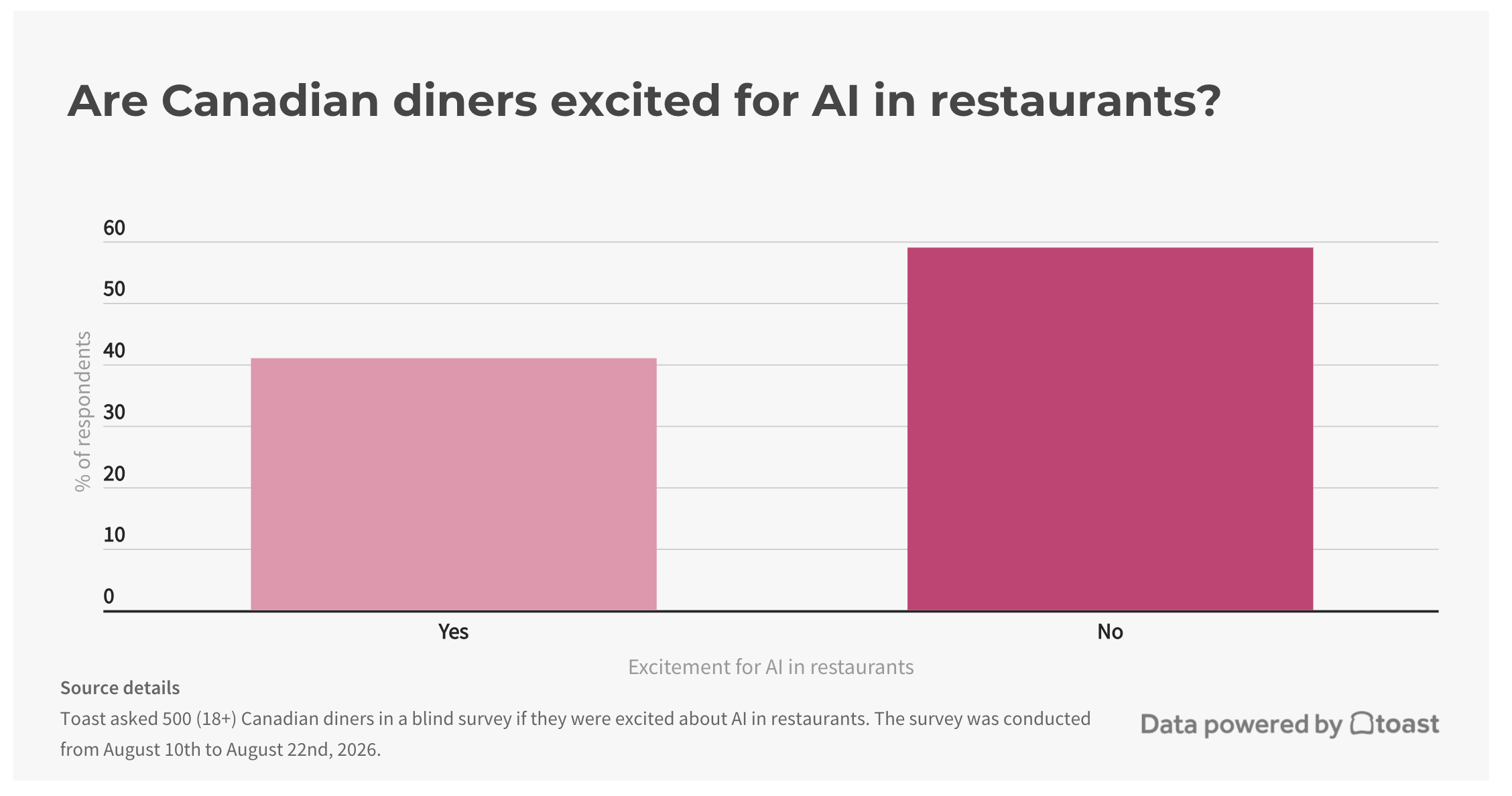
Guests rated resolving complaints (25%) and answering allergen and dietary questions (23%) as the least appropriate places for AI. 44% say they'd simply rather deal with a person, and 48% say knowing they can easily reach a human would make them trust restaurant AI more.
Keep a person on complaints, allergens, and special requests.
Make it easy for guests to reach someone on every channel.
Use the time AI saves you to put more people on the floor, not fewer.
7. AI-driven pricing
This is the one to watch. 55% of diners didn't know some restaurants use AI to adjust prices, and 62% say prices that change based on time, demand or personal data would give them a less favourable view of the restaurant. 69% support rules requiring restaurants to disclose it.
If you use dynamic pricing, be upfront about it.
Use AI to understand menu profitability, not to surprise guests at checkout.
The Independent Advantage
Here's a stat worth sharing with your team:
71% of diners think big chains have an edge because of AI. But 40% say they're less likely to choose a restaurant that uses AI over an independent that doesn't.
For Alberta independents, that's the opportunity. Use AI behind the scenes where margins are tight, and lead with the hospitality guests come to you for.
The 15-Minute AI Reality Check
Try this at your next management meeting.
Ask your team three questions:
What task took the most hours last week that didn't involve a guest?
Where would we never want a guest to deal with anything but a person?
If we got three hours a week back, where would we spend them?
Your answers are your 2027 AI plan.
See What AI Built for Restaurants Looks Like
Toast IQ is an AI assistant built into the Toast platform. It uses your restaurant's own data to answer questions, surface insights on sales and scheduling, and take care of routine tasks, so your team has more time for guests.
Read the full report: AI Use in Canadian Restaurants: Data and Insights
Methodology: Based on two blind surveys conducted by Toast via Pollfish, August 10–22, 2026, of 400 Canadian restaurant managers and 500 Canadian diners. Statistics on AI users reflect 194 managers currently using AI tools. Some percentages are rounded.